

Nature enthusiasts, conservation experts, and emergency responders attended Transition Habitat Conservancy’s annual fundraiser, held at the Wrightwood Place on Saturday, Oct. 5.
Since 2005, Transition Habitat Conservancy in Pinon Hills has served as a vital land steward for the Mojave Desert and mountain transition regions. As an accredited land trust, the organization has protected habitats from destruction and acquired more than 10,000 acres in Los Angeles and San Bernardino counties.
“Transition Habitat Conservancy has been working for nearly 20 years, and since our founding, we have grown from a grassroots effort to a respected leader in land conservation, safeguarding thousands of acres of critical habitat across the desert,” said Executive Director Sam Easley during his welcome speech.

Their annual fundraiser highlighted several important efforts the organization has made to protect vital species and included presentations from four keynote speakers—biologists and wildlife experts who discussed their work and findings to improve conservation efforts alongside Transition Habitat Conservancy.
SAVING THE DESERT TORTOISE
Renowned tortoise biologist Tim Shields spoke about his partnership with Transition Habitat and how, together, they are developing creative and technological solutions to help save the endangered desert tortoise from extinction.
“The exciting thing about the work we’re doing with Transition Habitat Conservancy is that we’re applying emerging technology,” said Shields, who mentioned that with THC’s help, they received four years of grant funding for their Desert Tortoise Conservation Innovation Project.
PROVIDING HABITAT FOR THE SWAINSON’S HAWK
Biologist Rainey Barton of Bloom Biological also gave an update about the status of the Swainson’s hawk, a threatened species. Barton reported seeing a recent increase in migrating numbers in North America, studied over the past five years.
“To ensure that Swainson’s hawks persist on the landscape, it’s vitally important that we both preserve nesting and foraging habitats in the Antelope Valley,” Barton said, praising Transition Habitat for preserving over 5,000 acres of the hawk’s critical habitat. “Not only are they preserving that habitat, but they are also working to restore it, making it even more beneficial as nesting and foraging habitat for the Swainson’s hawk.”
TEACHING ABOUT MONARCH BUTTERFLIES
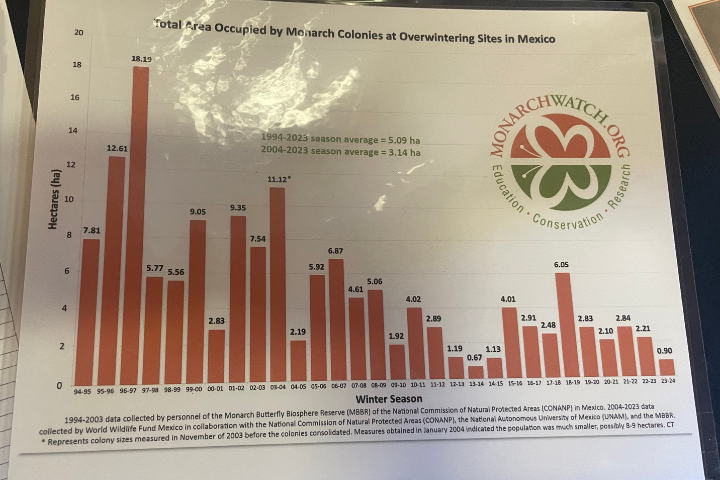
Unlike the Swainson’s hawk, which is seeing an increase in numbers, the monarch butterfly isn’t faring as well. Transition Habitat board member Gina Carpenter provided an update about the species, which has seen dwindling numbers this year, among the lowest in the past decade. However, Transition Habitat’s community outreach events and milkweed distribution have allowed the organization to receive a significant grant to continue its work to save the butterflies.
LEARNING ABOUT MOUNTAIN LIONS
Sarah Berryman, a local biologist for Transition Habitat and the new Director of Conservation, provided an update on mountain lions and western Joshua trees.
“We are also working with Conservation Lands Foundation, another nonprofit, to provide paid internships for students to catalog the vast database of mountain lion photos, so we can share this data with our state partners at CDFW to benefit lion conservation,” said Berryman, who noted that they are also collecting hair and scat samples to track lion movement and create wildlife corridors to keep them safe.

REPLANTING WESTERN JOSHUA TREES
Transition Habitat is also proactively protecting the threatened western Joshua tree by growing and replanting it. Some studies project the species may become extinct within the next century.
“We are practicing various restoration techniques with our Joshua trees, like planting sprouts, to reforest areas that have burned or historically supported Joshua trees,” said Berryman, who wrote about this well-recognized desert symbol in the September issue of NewsPlus and announced Transition Habitat’s acquisition of 323 acres of Joshua tree woodland adjacent to the western border of Pinon Hills.
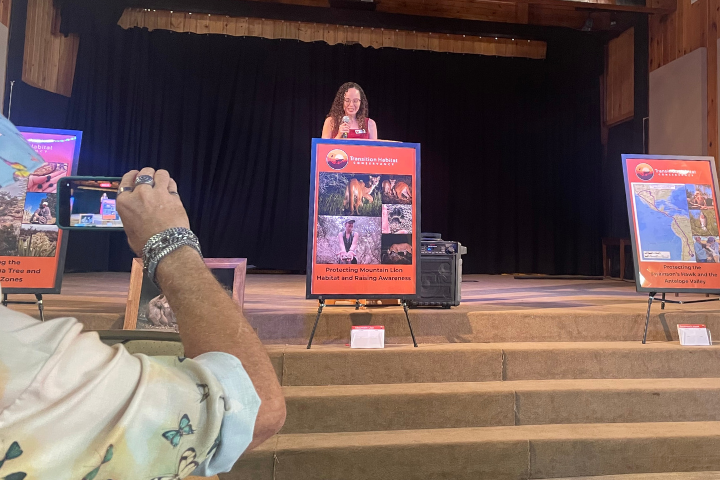
At the end of the presentations, Transition Habitat Conservancy presented the Bridge Fire emergency responders in attendance with wildlife artwork and photographs of mountain lions and bears captured on THC land.
“This is our first time holding this fundraiser here in Wrightwood. I also want to thank our first responders, our sheriff’s department, as well as firefighters and all first responders for working so hard to save these lands that we love,” said Director of Conservation Sarah Berryman.
The annual event also included a silent auction and a live auction, where mesmerizing wildlife photography was purchased by the highest bidders, with all proceeds benefiting Transition Habitat Conservancy.

To learn more about Transition Habitat Conservancy and the work they are doing to protect land, habitats, and species, visit their website at transitionhabitat.org and follow them on Facebook or Instagram for updates on stewardship, events, and volunteer efforts.
View all presentations from the 2024 Transition Habitat Conservancy Fundraiser online. (Event video by THC and Scott Brown)