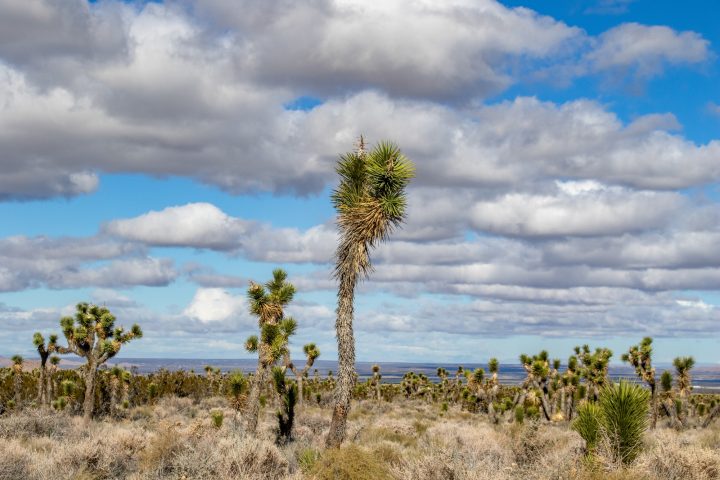
The Western Joshua tree is one of the most well-recognized symbols of the high desert. This special plant, Yucca brevifolia, only lives in the Mojave Desert. The Mojave Desert is the largest of California’s three deserts but the smallest in North America. The Mojave spans from Southern California to Arizona, Nevada, and Utah. The Western Joshua tree can only live in certain areas of the Mojave Desert, mostly consisting of the California portion and slightly into Nevada. Due to the large range of temperatures and precipitation across the Mojave, this limits the range of the tree even further. Due to the ongoing drought and swings in available precipitation, research suggests that the tree will have less available habitat in the coming decades.
Here in the Tri-Community area of Phelan, Pinon Hills, and the northern portion of Wrightwood, we are fortunate to have dense stands of these unique and wonderful trees. Did you know that the Joshua tree blooms in response to frost and that after it blooms, the tree creates a new branch? Or that it has a very special symbiotic relationship with the Yucca moth, without which the trees would not be pollinated and subsequently produce seeds? The human-Joshua tree relationship also goes far back in time. The Maara’yam (Serrano) people utilize the plant as a source for fiber-like materials to make everyday items. The blossoms of the plant were traded among Native communities. The tree has become a modern-day icon for our desert communities and represents part of our heritage and culture, just like the desert tortoise.
Transition Habitat Conservancy (THC) is dedicated to protecting wild areas with Joshua tree woodland for future generations to enjoy and to protect our high-desert heritage. As of this year, we are holding the conservation easement for 323 acres of newly acquired Joshua tree woodland adjacent to the western border of Pinon Hills. This woodland will now be managed and protected in perpetuity. As the conservation easement holder for this newly saved woodland, THC’s role is crucial in ensuring the long-term protection and management of lands like these. We are responsible for monitoring the properties to ensure compliance with the conservation goals and legal requirements. Our oversight guarantees that the ecological values are maintained and are successful in perpetuity. This is a significant step forward in safeguarding these vulnerable species and maintaining the ecological balance and beauty of our desert landscapes.
This area is filled with gorgeous Joshua trees of all ages. Many animals call this place home, and we observed coyote dens, black-tailed jackrabbits, families of California quail, multiple loggerhead shrikes, red-tailed hawks, and many wildflowers this past spring. We are so excited to share this new conservation win with you!
To celebrate the Joshua tree conservation occurring across Southern California, the Lancaster Museum of Art and History (MOAH) is hosting The Desert Forest: Life with Joshua Trees exhibition as part of the Getty PST ART: Art & Science Collide initiative. The exhibition sheds light on the endangered Joshua tree and the fragile Mojave Desert ecosystem that sustains it. The project integrates natural history, Indigenous knowledge, public policy, scientific research, and artistic expressions to emphasize the challenges facing the Joshua tree and conservation efforts. With a focus on climate change, development, wildfires, and other threats, the exhibition explores the symbiotic relationships between Joshua trees, soil fungi, and moth pollinators, engaging a diverse audience interested in arts and environmental issues. The exhibition’s opening reception will take place on Saturday, Sept. 7, 2024, from 2 to 4 p.m., and it will remain on view from Saturday, Sept. 7, 2024, to Sunday, Dec. 29, 2024.
Our very own board vice president, Geary Hund, contributed a chapter to the newest Joshua tree book, Conserving the Joshua Tree in an Age of Climate Change, that will be featured at the exhibition. Some of our work on Joshua tree restoration and conservation will be featured.
Visit MOAH’s website for your tickets to either the opening reception or any of the dates from Sept. 7 to Dec. 29.