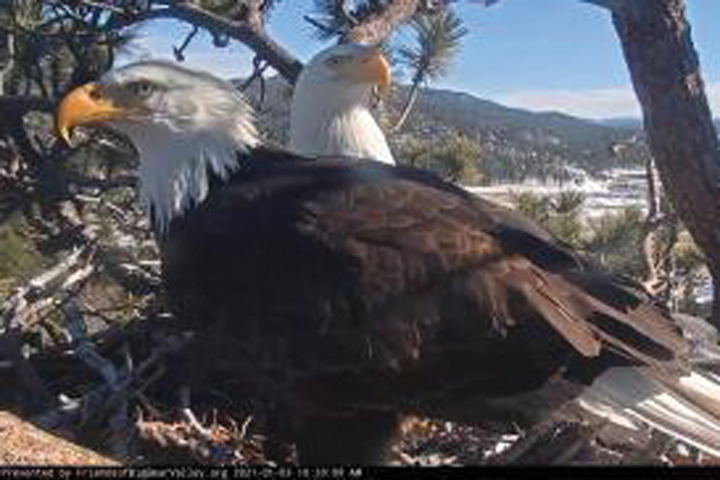
Did you know? The Bald Eagle has been the national emblem of the United States since 1782.
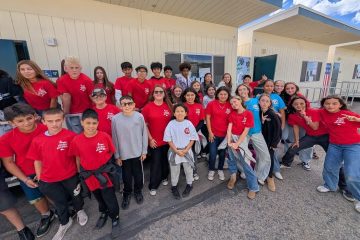
The votes are in for the names of Jackie and Shadow’s two eaglets. Out of 63,915 submitted names, 30 were randomly selected and sent to Big Bear Valley third-grade students for the final vote. Chick #1 was named Sandy, receiving 30 student votes, while Chick #2 was named Luna, with 25 votes.
This past April was a busy and exciting month for Jackie and Shadow, as viewers watched the hatching of their two new chicks. The eggs were laid on February 24 and February 27. About 35 days after the second egg was laid, “pip watch” began on March 31. A “pip” is the tiny crack or hole that appears in the shell when a chick begins to hatch.
The first pip was spotted on April 3 in Egg #1, followed by a second pip on April 4 in Egg #2. It can take up to two days for an eaglet to fully hatch. Chick #1 emerged on April 4, while Chick #2 hatched on April 5.
Throughout April, the eaglets reached several developmental milestones. At 2 to 3 weeks old, they begin “wingers,” shaky little flaps while sitting down. At 4 to 5 weeks, they start the “slap,” standing up and flapping strongly enough to hit the nest floor and even their siblings. By mid-May, at 6 to 7 weeks, they begin the “hover,” briefly lifting their feet off the nest. By late May to early June, at around 8 weeks old, sustained hovering, known as “the helicopter,” signals they are nearly ready to fledge.
Jackie and Shadow continued to brood and protect the chicks while making frequent trips to bring fish to the nest. Feedings reached as many as 17 times per day. Meanwhile, the eaglets are undergoing rapid feather growth, transforming from tiny fluff balls to nearly 80 percent of their adult size in just four to five weeks. Around April 22, each eaglet weighed about three pounds and stood approximately one foot tall.
The Friends of Big Bear Valley shared an interesting fact about newly hatched eaglets called the “Built-In Lunchbox.” Just before hatching, the chick absorbs the remaining yolk sac into its body. This provides all the proteins, fats, water, and antibodies needed to sustain the chick during the strenuous hatching process and its first 24 to 72 hours of life.
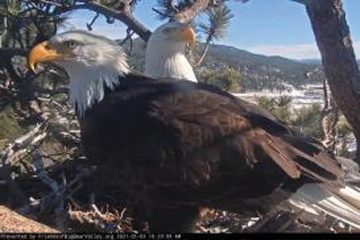
The public can continue watching Jackie, Shadow, Sandy, and Luna thanks to the Friends of Big Bear Valley, owners and operators of the live eagle cam. More information can be found at the Friends of Big Bear Valley website or on their YouTube channel.
The organization is also asking for public support in its effort to preserve Moon Camp, an undisturbed area on Big Bear Lake where bald eagles perch and forage. The proposed luxury housing development and marina would impact the nearly 63-acre lakefront property, which also contains rare and endangered plant species. After more than two decades of public opposition, the developer has agreed to give the San Bernardino Mountain Land Trust a limited option to purchase and permanently protect the land. Information on the Save Moon Camp fundraiser is available through the Friends of Big Bear Valley website friendsofbigbearvalley.org and at savemooncamp.org.