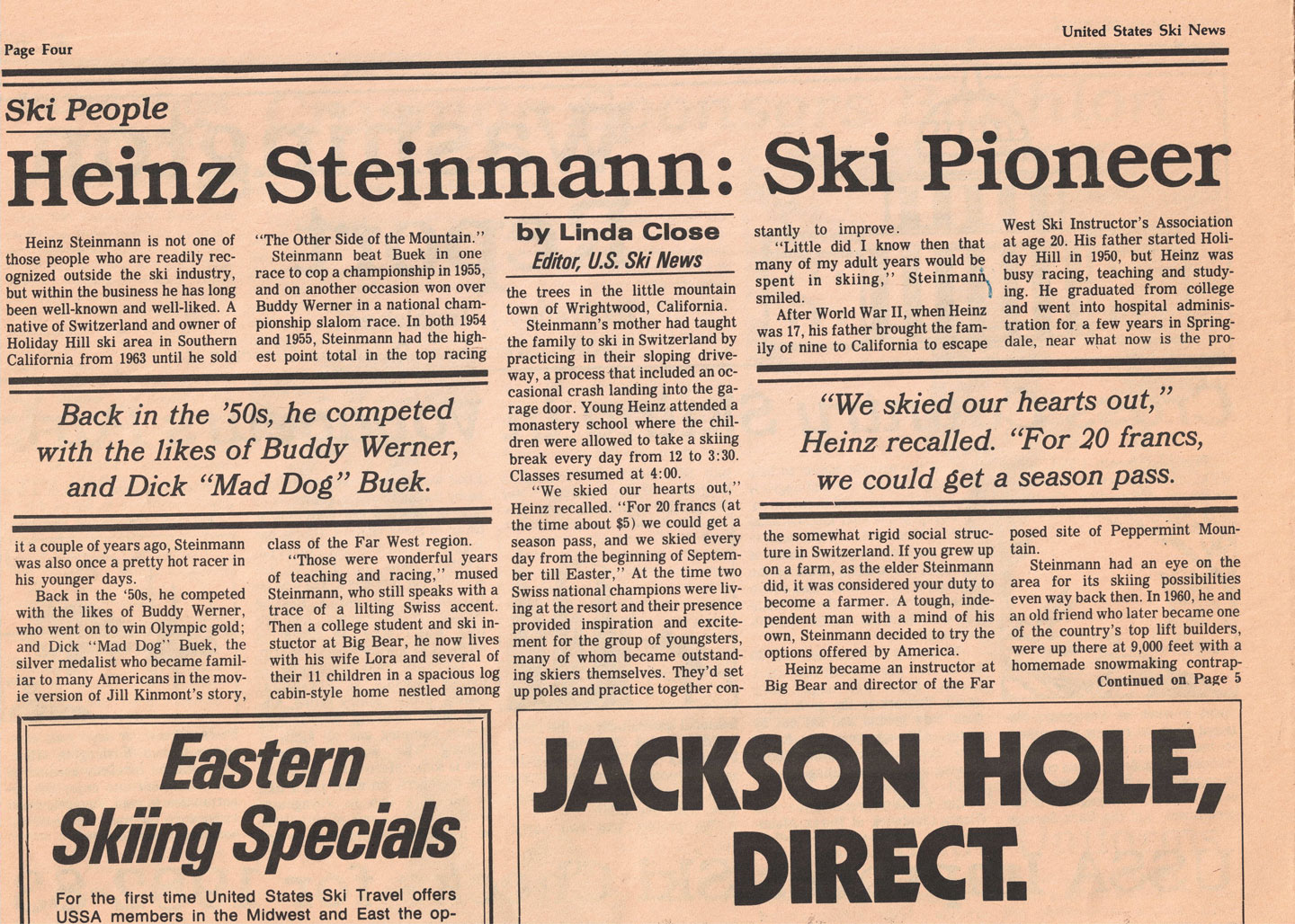
EDITORS NOTE: The following article was originally published in U.S. Ski News by editor Linda Close. It highlights the remarkable life of Heinz Steinmann, a pioneer in the ski industry and a beloved figure in the community of Wrightwood, California. With the recent passing of Mr. Steinmann, his family and friends wanted to share this tribute to his contributions to the world of skiing, ensuring that his legacy is remembered and celebrated.
United States Ski News
Heinz Steinmann: Ski Pioneer
by Linda Close, Editor, U.S. Ski News
Publication Date: Unknown
Heinz Steinmann is not one of those people who are readily recognized outside the ski industry, but within the business, he has long been well-known and well-liked. A native of Switzerland and owner of Holiday Hill ski area in Southern California from 1963 until he sold it a couple of years ago, Steinmann was also once a pretty hot racer in his younger days.
Back in the ‘50s, he competed with the likes of Buddy Werner, who went on to win Olympic gold, and Dick “Mad Dog” Buek, the silver medalist who became familiar to many Americans in the movie version of Jill Kinmont’s story, The Other Side of the Mountain.
Steinmann beat Buek in one race to win a championship in 1955, and on another occasion, won over Buddy Werner in a national championship slalom race. In both 1954 and 1955, Steinmann had the highest point total in the top racing class of the Far West region.
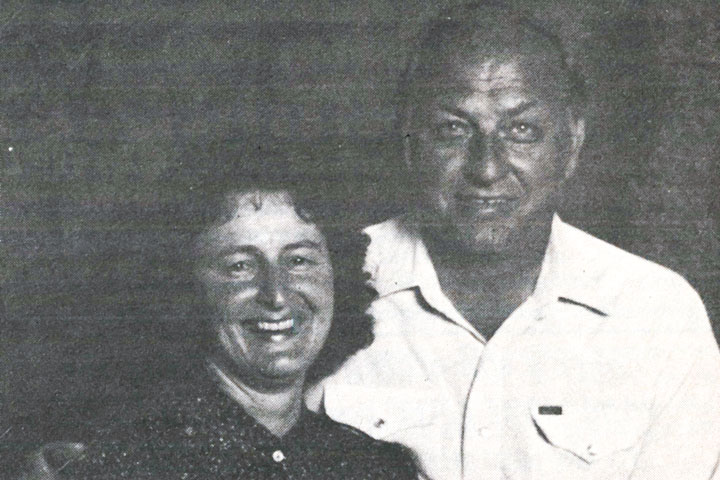
“Those were wonderful years of teaching and racing,” mused Steinmann, who still speaks with a trace of a lilting Swiss accent. Then a college student and ski instructor at Big Bear, he now lives with his wife Lora and several of their 11 children in a spacious log cabin-style home nestled among the trees in the little mountain town of Wrightwood, California.
Steinmann’s mother had taught the family to ski in Switzerland by practicing in their sloping driveway, a process that included an occasional crash landing into the garage door. Young Heinz attended a monastery school where the children were allowed to take a skiing break every day from 12 to 3:30. Classes resumed at 4:00.
“We skied our hearts out,” Heinz recalled. “For 20 francs (at the time about $5), we could get a season pass, and we skied every day from the beginning of September till Easter.” At the time, two Swiss national champions were living at the resort, and their presence provided inspiration and excitement for the group of youngsters, many of whom became outstanding skiers themselves. They’d set up poles and practice together constantly to improve.
“Little did I know then that many of my adult years would be spent in skiing,” Steinmann smiled.
After World War II, when Heinz was 17, his father brought the family of nine to California to escape the somewhat rigid social structure in Switzerland. If you grew up on a farm, as the elder Steinmann did, it was considered your duty to become a farmer. A tough, independent man with a mind of his own, Steinmann decided to try the options offered by America.
Heinz became an instructor at Big Bear and director of the Far West Ski Instructors Association at age 20. His father started Holiday Hill in 1950, but Heinz was busy racing, teaching, and studying. He graduated from college and went into hospital administration for a few years in Springdale, near what now is the proposed site of Peppermint Mountain.
Steinmann had an eye on the area for its skiing possibilities even way back then. In 1960, he and an old friend, who later became one of the country’s top lift builders, were up there at 9,000 feet with a homemade snowmaking contraption, trying to make snow. Their experiment was less than successful.
Steinmann brought his family downstate to the mountains near San Bernardino when his father sold him Holiday Hill in 1963. He and his wife already had five children, and they settled in a home right at the ski area. “One of the nicest things was that our youngsters were part of the business,” recalled Steinmann, who believes young people should work. “We always had lots of jobs for them.”
“Skiing is one of the few natural sports that a family can participate in together,” Steinmann observed. “Some of the most marvelous moments I’ve had have been spent skiing with my children and my wife. In our times, I think that’s an important aspect of life—sharing nature.”
Things have changed a lot since Steinmann’s early days in the sport, and not always for the better, he thinks. “There does not seem to be enough discipline in the sport today,” Steinmann says. “People are jumping, whirling, out of control. They get hurt over and over again, and that shouldn’t be part of the sport.”
“Skiing is difficult to learn, but once you do, the joy comes in mastering a controlled speed down the hill,” he contends. “If you’re out of control, you’re a menace to yourself and others. People would enjoy skiing so much more if they would learn to ski better. And the more they enjoy it, the more they’ll go skiing.”
Steinmann believes there is a real need for structured programs of instruction, especially for young people, so they would know what level they are skiing at and have the incentive to practice and acquire the skills to graduate from one to another.
Building post offices is Steinmann’s method of making a living these days. “My conclusion is that the ski business must be one of the toughest, because it’s so easy to be successful at something else,” Steinmann chuckles. He works a couple of days a week and devotes the rest to raising thoroughbred racehorses and spending time with his family.
But benefits from the sport have spilled over into other aspects of his life, Steinmann says. “It does teach you self-reliance,” he pointed out, “especially when you have close calls. And I think it makes an individual out of you and helps you to understand nature better.”