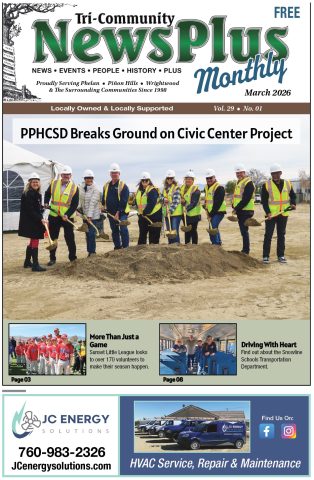

The Phelan Piñon Hills Community Services District has taken a major step toward building its new Civic Center and Emergency Operations Center, approving an $11.96 million construction contract that will bring a long-planned community project to life. The District Board voted 3–2 to award the contract to Spec Construction Co., Inc. of Ontario, California, and to deny a protest that had been filed after the bid opening.
Assistant General Manager George Cardenas, who has overseen the project’s engineering and bid process, said the District has worked toward this goal for more than a decade. “This project has been 13 years in the making,” Cardenas said. “We’re finally in a position to move forward.”
The Civic Center and Emergency Operations Center will be constructed on District-owned property at 9535 Sheep Creek Road, adjacent to the Phelan Community Park and Napa Auto Parts. The facility will consolidate District offices, provide public meeting rooms, and include a 5,000-square-foot community hall that can host local gatherings and emergency coordination efforts. “Part of the building will be for community use—about 5,000 square feet,” said General Manager Don Bartz. “It will give residents a place for larger gatherings and serve as our local operations center when emergencies happen.”
This will be the first and only Emergency Operations Center in the Tri-Community—one designed to be used not only by PPHCSD staff but also by partner agencies such as the County Sheriff’s Department, Cal Fire, County Fire, CERT volunteers, local school districts, and state and federal entities. The EOC is funded in part through a federal grant administered by the Federal Emergency Management Agency (FEMA) in coordination with the California Office of Emergency Services (Cal OES). Its purpose is to improve the region’s disaster readiness in an area that faces multiple hazards, including high wildfire risk, periodic power shutoffs under Southern California Edison’s Public Safety Power Shutoff program, flood-prone zones, and proximity to the San Andreas Fault, which is only five miles away.
The total project cost, including furnishings, equipment, and contingencies, is estimated at approximately $14 million. Bartz emphasized that most of the project funding will not come from water rates, but instead from a mix of grants, loans, and other District funds. Primary funding sources include a $2 million FEMA grant for the emergency operations component, $500,000 from San Bernardino County, a $6 million low-interest loan approved in 2023, and about $3.5 million from District reserves in its parks and governmental funds. Only $500,000 comes from the water enterprise fund, covering the share of the building devoted to water-system operations.
To offset costs, the District expects to generate additional income from leasing its current office building, which is anticipated to be occupied by the Sheriff’s Department, and from commodity-fee revenues at the Republic Services site at the former Meadowbrook Dairy in El Mirage once it becomes operational. “We understand this is a large project,” Bartz said. “We’re committed to keeping it within budget and managing water rates carefully. The water fund is only one piece of the overall plan, and most of the cost is being covered through other sources.”
During board discussion, members acknowledged the project’s scale and the importance of transparency for ratepayers. Director Chuck Hays expressed concern about long-term affordability for residents on fixed incomes. “By 2028, people could be paying $80 a month just to have a one-inch meter before they use a drop of water,” Hays said. “I just can’t see supporting a project of this size and scope in a community where there are people who have to make a choice between paying their water bills or buying groceries.”
District staff clarified that water-rate revenues support only the water enterprise portion of the facility, while the majority of the project is funded through other District accounts and federal grants. Bartz noted that rate increases have already been kept below projections, with last year’s adjustment limited to six percent, which was well under the 16 percent maximum authorized. “We’ve done a lot of the heavy lifting already with our water infrastructure,” Bartz said. “We’ll continue working to minimize rate impacts while investing in facilities that serve the whole community.”
Fourteen competitive bids were submitted for the project, most ranging between $12 million and $13 million. CPM Construction Management, the firm overseeing the project, verified that Spec Construction Co. met all licensing, bonding, and workers’ compensation requirements and recommended awarding the contract. The bid came in about 14 percent below earlier cost estimates, and CPM’s past projects have typically finished within one percent of budget.
Construction is expected to begin in November, following a pre-construction meeting, with completion anticipated within approximately 18 months. Site grading will also prepare portions of the adjacent 14-acre park expansion, utilizing soil from the Civic Center pad to shape the future park area and manage drainage—an efficient way to prepare both properties simultaneously.
While two directors voted against the measure, others stated that the facility will provide long-term value for residents and enhance local emergency preparedness. Vice President Deborah Philips, who voted in favor, said she carefully considered the cost before deciding that the community benefits were worth it. “I am low-income and have struggled over the years paying bills,” Philips said. “But I can see this being an improvement for the community by having a larger space for the public to use and an emergency facility we can all rely on.”
Board President Rebecca Kujawa said the project represents a forward-looking investment for the Tri-Community. “It’s more than just a building,” Kujawa said after the vote. “It’s an investment in the future of this community, its safety, its resilience, and its ability to come together.”
Pre-construction activities are now underway, and groundbreaking is expected later this fall. Once completed, the new Civic Center and Emergency Operations Center will serve as a central hub for District operations, emergency coordination, and community events. Built with the goal of strengthening the Tri-Community’s ability to serve, respond, and recover for decades to come.